Most foreign companies that come to us have already made up their minds — they want a Pte. Ltd., and they want it set up quickly. That is often the right call. But not always.
Singapore offers four distinct ways for a foreign company to establish a presence here: a Subsidiary, a Branch Office, a Representative Office, and Transfer of Registration.
Each one sits differently under the Companies Act, carries different tax treatment, and comes with its own set of compliance obligations. Picking the wrong structure means either over-committing before you are ready, or under-structuring in ways that limit what you can do here.
This guide covers what each option actually involves — the legal position, the requirements, and the practical trade-offs.
Comparison at a Glance
Feature | Subsidiary | Branch Office | Representative Office | Transfer of Registration |
|---|---|---|---|---|
Legal Status | Separate legal entity (locally incorporated) | Extension of the foreign parent; not a separate entity | Not a legal entity | Becomes a Singapore-incorporated company |
Liability | Limited to shareholders | Parent company bears full liability | Parent company bears full liability | Existing obligations and rights carry over |
Permitted Activities | Any lawful business (sector licensing may apply) | Same activities as the parent company | Market research and liaison only — no revenue | Full commercial operations as a Pte. Ltd. |
Corporate Tax | 17%; Start-Up and Partial Exemptions available | 17% on Singapore-sourced income; Partial Exemption only | Not applicable | 17%; applicable exemptions post-registration |
Key Personnel | 1 local director, 1 company secretary, 1+ shareholder | 1 locally resident authorised representative | 1 Chief Representative (EP required to work here) | 1 local director, 1 company secretary post-registration |
Annual Compliance | Annual Return and financial statements with ACRA | Annual Return for both the SG branch and parent company | No statutory filing under the Companies Act | Same as any Singapore-incorporated company |
ACRA Fee | SGD 300 | SGD 300 | SGD 200 (via EnterpriseSG) | SGD 1,000 |
Best For | Full market entry with independent operations | Operating under the parent brand with direct HQ control | Testing the market before committing | Relocating the company’s legal domicile to Singapore |
1. Subsidiary Company
A subsidiary is a Singapore-incorporated company — most commonly set up as a Private Limited Company (Pte. Ltd.). It exists as a separate legal entity from its foreign parent, which means the parent’s liability does not automatically extend to the subsidiary’s obligations.
This separation matters more than people realise. It affects how contracts are structured, how assets are held, and what happens if things go wrong. A subsidiary can own property, sue and be sued, and build a standalone commercial track record in Singapore.
From a tax standpoint, a subsidiary that exercises its control and management here qualifies as a Singapore tax resident. That opens the door to Start-Up Tax Exemption for the first three years of assessment — where a significant portion of the first SGD 200,000 of chargeable income is exempt from tax — and Partial Tax Exemption thereafter.
The corporate tax rate is 17%, but qualifying companies in the early years pay considerably less in practice.
100% foreign ownership is permitted. There is no requirement for a local shareholder.
What you need
- At least one shareholder — an individual or a corporate entity
- At least one locally resident director (Singapore Citizen, Permanent Resident, or holder of an eligible pass such as an Employment Pass)
- A company secretary appointed within six months of incorporation
- A registered office address in Singapore, open to the public for at least three hours on each business day
- Minimum paid-up capital of SGD 1
Registration fee: SGD 300, filed through ACRA’s BizFile+ portal. Foreign companies must appoint a licensed Corporate Service Provider to submit on their behalf.
For most foreign companies entering Singapore with a genuine intention to do business here, a subsidiary is the right starting point. It gives you the most room to operate and the best access to Singapore’s tax framework.
2. Branch Office
A branch office is not a new company. It is the foreign parent company operating in Singapore under its own name. There is no separate legal entity — the parent and the branch are the same in law. That means the parent is fully liable for everything the branch does here.
Unlike a subsidiary, where liability sits within the Singapore entity, a branch exposes the parent’s global assets to claims arising out of Singapore operations.
Companies that choose this structure are typically comfortable with that exposure — or have strategic reasons, such as brand continuity or internal group structure, that make a branch the better fit.
Tax-wise, a branch is treated as a non-resident company. It pays 17% on Singapore-sourced income and foreign income received here, but it does not qualify for Start-Up Tax Exemption.
Many government grants that require at least 30% local shareholding are also off the table. On the filing side, the branch has to submit annual returns for both its own accounts and those of the parent company.
For multinational professional services firms, financial institutions, or companies that want to operate in Singapore as an extension of their global entity rather than creating a separate Singapore company, a branch can make sense. For most others, a subsidiary is the cleaner structure.
What you need
- At least one authorised representative who is ordinarily resident in Singapore
- A registered office address in Singapore, accessible for at least five hours between 9 a.m. and 5 p.m. on business days
- Updates to ACRA within 30 days of any change to the authorised representative, company name, or registered address
Registration fee: SGD 300, filed through ACRA’s BizFile+ portal via a licensed Corporate Service Provider.
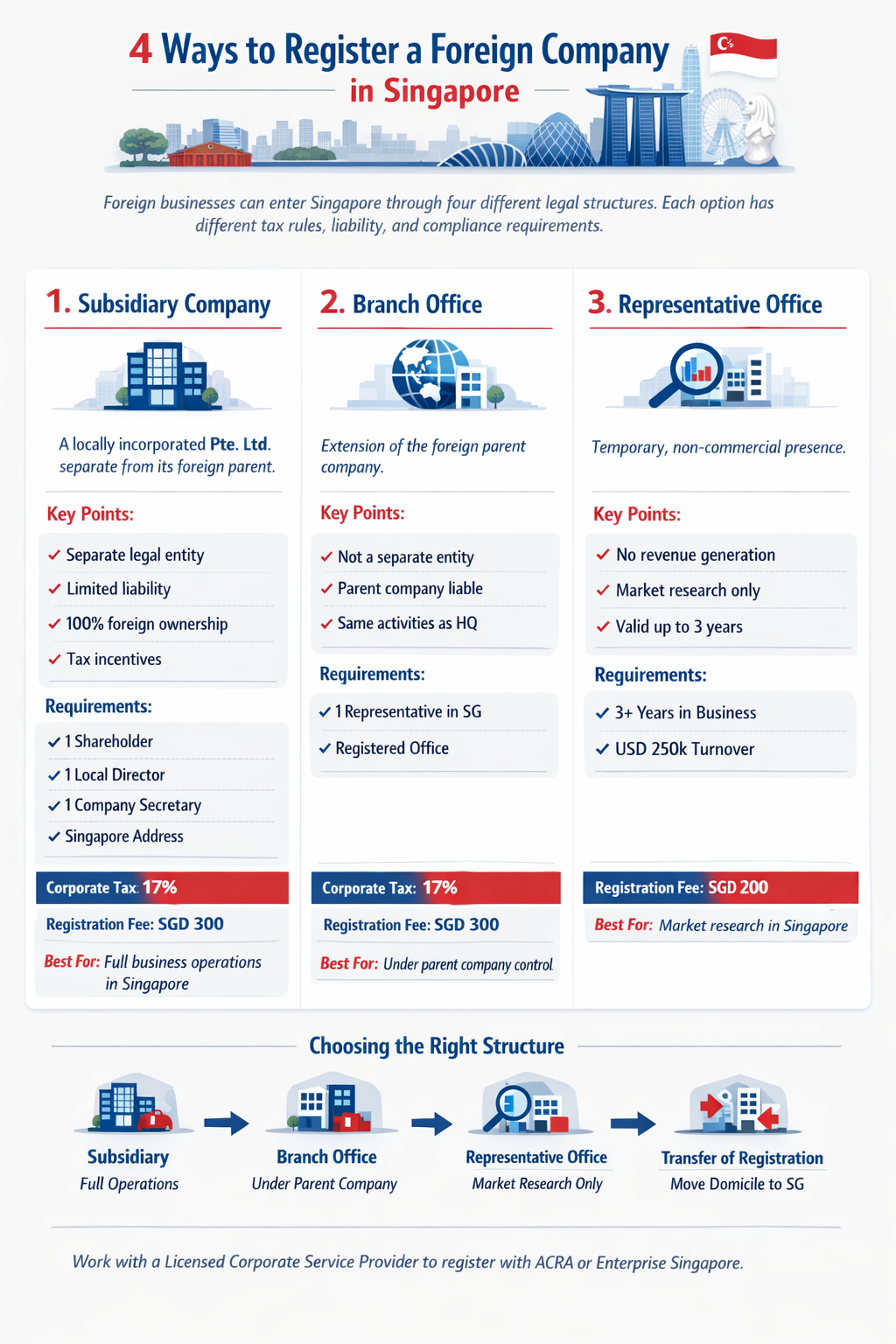
3. Representative Office
A Representative Office (RO) is a temporary, non-trading presence. It has no legal standing as a business entity, cannot enter into commercial contracts, and cannot earn revenue. What it can do is limited to market research, feasibility work, and building contacts — essentially, the groundwork that precedes a proper market entry.
Approvals are issued for one-year periods, renewable annually, for up to three years. After that, companies that want to stay in Singapore need to convert to either a branch or a subsidiary.
An RO is most useful for companies that are still evaluating whether Singapore makes sense for them, not as a permanent structure.
Eligibility requirements are more restrictive than for the other structures, and the application goes through Enterprise Singapore rather than ACRA.
What you need
- The foreign company must have been in operation for at least three years
- Annual turnover of at least USD 250,000
- A Chief Representative appointed to oversee the RO’s activities in Singapore
- No more than four staff members in Singapore
- A CorpPass Admin account with a valid NRIC or FIN — where this is not available, a local proxy must be appointed to file on the company’s behalf
Registration fee: SGD 200. Filed through Enterprise Singapore, not ACRA.
One point that is often missed: being appointed Chief Representative does not give a foreigner the right to work in Singapore. An Employment Pass from the Ministry of Manpower is still required before the individual can take up the role.
4. Transfer of Registration (Inward Re-Domiciliation)
This is a different kind of option from the other three. Transfer of Registration — or inward re-domiciliation under the Companies Act — is for a foreign company that wants to move its legal home to Singapore, not just open an office here.
The company shifts its place of incorporation to Singapore while keeping everything intact: its name, its corporate history, its contracts, its assets, its liabilities. It does not wind up and restart.
Once the transfer is complete, the company is registered as a Singapore Pte. Ltd. and falls under the same rules as any locally incorporated company.
Within 60 days of completing re-domiciliation, the company must file proof of deregistration from its original jurisdiction. That deregistration process has to happen on the other end, too — the home country must permit outward re-domiciliation, and all requirements there must be satisfied first.
The eligibility bar is higher here, and the process involves coordinating legal requirements across two jurisdictions. This is not a structure most companies will encounter, but for those relocating their headquarters or legal base to Singapore, it is a cleaner path than winding down and reincorporating.
Eligibility Criteria
The company must satisfy at least two of the following three thresholds:
- Total assets exceeding SGD 10 million
- Annual revenue exceeding SGD 10 million
- More than 50 employees
Beyond the financial thresholds:
- The company must be solvent — able to pay its debts as they fall due — and must not be under any winding up, liquidation, or judicial management proceedings
- Outward re-domiciliation must be permitted by the home jurisdiction, with all local requirements there satisfied before applying in Singapore
- The application cannot be made for the purpose of defrauding creditors
Registration fee: SGD 1,000. This is the most document-intensive of the four pathways. Companies going this route typically need legal advice from counsel in both jurisdictions.
Choosing the Right Business Structure
For most foreign companies entering Singapore with a clear business plan, a subsidiary is the answer. It gives you full operational scope, limited liability for the parent, and access to Singapore’s tax incentive framework from day one.
A branch office makes sense if you need to operate here under your existing corporate identity and your parent company is comfortable holding direct liability for Singapore operations. A representative office is appropriate if you are still in the exploratory stage and have no immediate revenue plans. Transfer of Registration is for a very specific scenario — relocating the company’s legal domicile — and most businesses will not need it.
Whichever business structure you choose, compliance obligations start from the date of registration. Resident directors, company secretaries, registered office addresses, annual returns, and statutory registers are not optional — they are mandatory from the outset.
Foreign companies are required to work with a licensed Corporate Service Provider to register with ACRA or Enterprise Singapore.
If you are working through this decision and want a clearer picture of which structure fits your situation, we, HC Consultancy, are happy to walk through it with you. We handle the full registration process and provide ongoing corporate secretarial support to keep your Singapore entity compliant as it grows.
Frequently Asked Questions
1. How long does company registration take?
For a subsidiary or branch office, ACRA typically processes the application within one to three business days once all documents are in order. In practice, the preparation of documents — particularly for foreign-incorporated parent companies — takes longer than the registration itself. A representative office through Enterprise Singapore generally takes two to four weeks.
2. Do I need to be physically present in Singapore to register a company?
No. The entire process can be handled remotely through a licensed Corporate Service Provider. Directors and shareholders do not need to be in Singapore to incorporate. Documents can be signed and submitted electronically. What you do need is someone locally resident to serve as director — but that person does not have to be you.
3. What is a nominee director, and is it a common arrangement?
A nominee director is a locally resident individual appointed to satisfy the Companies Act requirement, while actual management decisions rest with the beneficial owners.
It is a legitimate and widely used arrangement for foreign-owned companies in Singapore. That said, a nominee director still carries statutory duties and legal responsibilities under Singapore law — this is not a passive role on paper. Any nominee arrangement should be documented properly, with a clear scope of authority and an indemnity in place.
4. What is the difference between a company secretary and a nominee director?
A company secretary handles statutory compliance — maintaining the company’s registers, filing annual returns, updating ACRA on changes, and ensuring the company meets its ongoing obligations under the Companies Act.
A nominee director is a board-level appointment made to satisfy the local residency requirement. The company secretary has no management authority; the nominee director holds a board position but typically does not participate in day-to-day operations. Both are mandatory appointments for a Singapore-incorporated company.
5. What are the ongoing compliance requirements after registration?
At a minimum, a Singapore-incorporated company must hold an Annual General Meeting (AGM – unless dispensed with by unanimous consent of shareholders), file an Annual Return with ACRA, and maintain up-to-date statutory registers including the Register of Directors, Register of Members, and Register of Registrable Controllers.
Financial statements must be prepared and, where applicable, audited. Companies must also notify ACRA of any changes to directors, shareholders, the company secretary, or the registered address within prescribed timeframes.
Missing these deadlines carries penalties — ACRA enforces compliance actively.
This article is for general informational purposes only and does not constitute legal advice. For advice tailored to your circumstances, please speak with a qualified corporate lawyer.