Every Singapore company, regardless of size or ownership structure, is subject to financial reporting and filing obligations once its first financial year closes. For many business owners — particularly those running their first Singapore entity — this is also when three terms come into focus for the first time: management accounts, unaudited financial statements, and audited financial statements.
These are not interchangeable. Each serves a distinct purpose, is prepared to a different standard, and is required in different circumstances. Treating one as a substitute for another leads to practical consequences: compliance gaps with ACRA, rejected financing applications, or documentation that falls short of what an investor or regulatory body requires.
This article explains what each document is, which companies in Singapore must have their accounts audited, and when each type of document will be expected of your business.
Why This Comes Up at the 1-Year Mark
When you incorporate a company in Singapore, ACRA gives you a grace period before compliance obligations kick in. But once your first financial year closes, the clock starts running on several deadlines:
- You must hold your Annual General Meeting (AGM), or pass a resolution to dispense with it.
- You must file your Annual Return with ACRA.
- You must prepare financial statements for the year.
- You must file your Estimated Chargeable Income (ECI) with IRAS within three months of your financial year-end.
- You must file your corporate tax return (Form C-S or Form C) within the year.
The financial statements you prepare for these purposes — and whether they need to be audited or not — depend on the size and structure of your company.
The 3 Financial Documents You Need to Understand
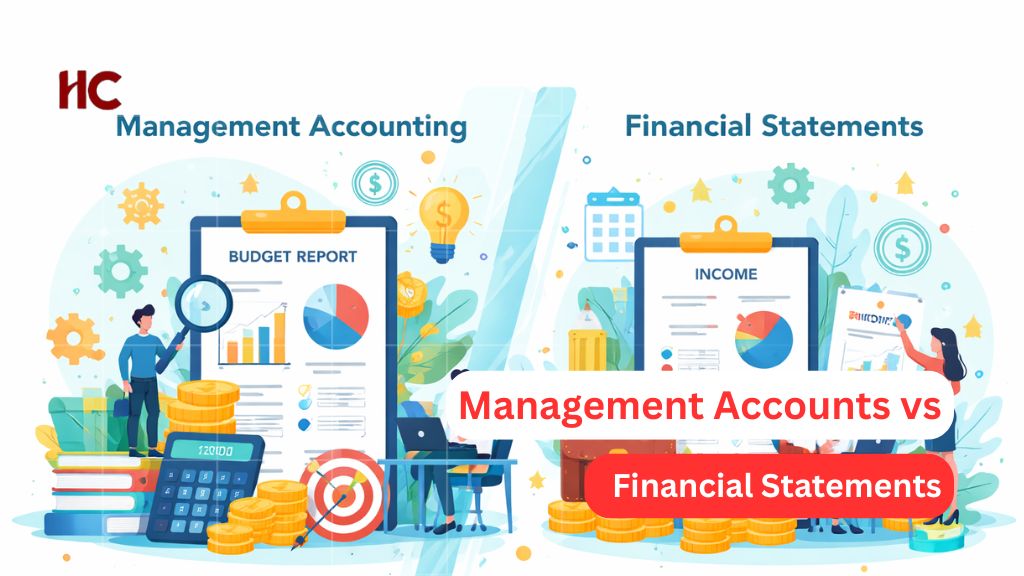
Management Accounts
Management accounts are internal financial reports prepared to help business owners and management make day-to-day decisions. There is no prescribed format under Singapore law — you decide what to include and how often to prepare them.
A typical set might cover monthly profit and loss, cashflow summaries, accounts receivable and payable ageing, and budget-versus-actual figures. These reports exist to answer operational questions: Is the business profitable this month? Where is cash going? Can we afford to take on a new hire?
Management accounts are not submitted to ACRA, IRAS, or any bank as a compliance document. They are a management tool, not a statutory one.
Unaudited Financial Statements
Unaudited financial statements are formal year-end reports prepared in accordance with Singapore Financial Reporting Standards (FRS). They follow a standardised structure:
- Statement of financial position
- Statement of profit or loss and other comprehensive income
- Statement of changes in equity
- Statement of cash flows
- Notes to the financial statements
These are prepared by your accountant and signed off by your directors. They are used for filing your Annual Return with ACRA, submitting your corporate tax return with IRAS, and presenting accounts to shareholders. They are not independently verified by an external auditor.
Many private companies in Singapore are legally permitted to file unaudited financial statements. Whether yours qualifies depends on your company’s size, covered in the next section.
Audited Financial Statements
Audited financial statements contain the same components as unaudited financial statements, with one addition: an independent auditor’s report issued by a registered public accounting firm.
The auditor examines your accounts, tests the underlying records, and provides an opinion on whether the financial statements present a true and fair view of your company’s financial position. That independent opinion is what lends the accounts credibility with banks, investors, regulators, and any party conducting due diligence on your business.
Audited accounts take longer to produce, cost more, and require your financial records to be well-organised before the audit begins.
At a Glance
Management Accounts | Unaudited Financial Statements | Audited Financial Statements | |
|---|---|---|---|
Purpose | Internal decision-making | Statutory compliance | Statutory compliance + independent assurance |
Format | Flexible | Singapore FRS | Singapore FRS |
Prepared by | Internal team or accountant | Accountant | Accountant + external auditor |
Independent review | No | No | Yes |
Legally required | No | For qualifying companies | For companies not exempt from audit |
Frequency | Monthly or quarterly | Annually | Annually |
Does Your Company Need to Be Audited?
This is the question most business owners ask first. The answer turns on whether your company qualifies as a “small company” under the Singapore Companies Act.
The Small Company Audit Exemption
A private company qualifies for audit exemption if it meets at least two of the following three criteria for the financial year:
- Annual revenue does not exceed S$10 million
- Total assets do not exceed S$10 million
- The number of employees does not exceed 50
Companies that qualify may file unaudited financial statements and are not required to engage an external auditor. This exemption is available to most Singapore-incorporated SMEs, including those owned by foreign entrepreneurs.
When the Exemption Does Not Apply
The exemption does not cover every private company. It does not apply if:
- Your company is part of a group, and the consolidated group exceeds the small company thresholds
- Your company holds certain regulated licences (such as those in financial services or capital markets)
- Your shareholders have passed a resolution requiring an audit
- Your company is a public company
If you are uncertain whether your company or its group structure qualifies, your corporate service provider or accountant can confirm this.
When You Will Need Each Financial Document
Management Accounts
These are primarily for internal use, but some external parties will ask for them — particularly investors assessing your current performance between audit cycles, or banks reviewing your cashflow position when your last set of annual accounts is more than six months old.
Unaudited Financial Statements
These are the minimum requirements for companies that qualify under the small company exemption. You will need them for your ACRA Annual Return filing, AGM documentation, and corporate income tax submission to IRAS.
Audited Financial Statements
These are required when your company does not qualify for the exemption, and are also expected in the following situations, regardless of exemption status:
- Bank loan applications above a basic threshold — most financial institutions require two to three years of audited accounts for significant credit facilities
- Government grant applications through agencies such as Enterprise Singapore
- Investor due diligence or capital-raising exercises
- Business sale or acquisition transactions
- Regulatory submissions in licensed industries
A Note for Foreign Business Owners
If you have set up a Singapore company as a subsidiary or holding vehicle, a few additional points are worth noting.
ACRA requires all Singapore companies to maintain accounting records and prepare financial statements in accordance with Singapore FRS. Your home country accounts do not satisfy this requirement.
If your Singapore entity is a subsidiary of a foreign group, the audit exemption is assessed at the group level. Even if your Singapore company is small, the exemption may not apply if the consolidated group exceeds the qualifying thresholds.
Singapore banks also require ACRA-filed financial statements when maintaining corporate accounts and processing credit facilities. Keeping your annual filings current is a practical requirement, not just a legal one.
Director Responsibilities
Whether your company is audited or not, directors in Singapore are legally responsible for ensuring that:
- Proper accounting records are maintained throughout the year
- Financial statements are prepared in accordance with FRS
- Annual Returns are filed with ACRA on time
- Shareholders have access to the financial statements
This applies equally to nominee directors. Corporate service providers acting as nominee directors will generally require that a company’s compliance obligations are kept current as a condition of the arrangement.
How the 3 Financial Documents Work Together

Management accounts, unaudited financial statements, and audited financial statements are not alternatives. They serve different purposes and different audiences.
Management accounts keep you informed throughout the year. Your annual financial statements — audited or unaudited — provide external parties with a formal record of your company’s financial position. The audit adds a layer of independent assurance that no internal document can provide.
There is also a practical benefit to maintaining clean management accounts throughout the year: when it comes to preparing your annual financial statements or undergoing an audit, your records are already in order. The process is faster, and the cost of any professional work involved is lower.
Where to Start
If your company has just completed its first financial year, the immediate priorities are:
- Confirm your financial year-end and filing deadlines with your corporate secretary
- Determine whether your company qualifies for the small company audit exemption
- Engage an accountant to prepare your financial statements in the correct format
- If an audit is required, appoint an auditor early — do not wait until close to the deadline
- Put in place a basic management accounts routine so you have visibility on your finances between annual filings
Know Your Financial Documents
Management accounts are for running your business. Financial statements — whether audited or unaudited — are for meeting your legal obligations and demonstrating your financial position to the outside world.
Most small Singapore companies qualify for the audit exemption and are only required to file unaudited financial statements. If your company grows, brings in investors, or requires bank financing beyond a basic threshold, audited accounts become necessary regardless of exemption status.
Understanding which document is required, and when, keeps your company in good standing with ACRA and IRAS — and ensures you are never caught unprepared when a bank, investor, or counterparty asks.
HC Consultancy advises businesses on corporate compliance, company structuring, and post-incorporation obligations in Singapore. If you have questions about your company’s financial reporting requirements, speak to our team.